Showing posts with label Oregon Women. Show all posts

Saturday, August 27, 2011

The Who and What of the Day

IMG_3189

It ‘s not natural to wake up before the sunrise.  I don’t care what anyone says.  When we got up this morning, it was well before the sun even thought about making an appearance.

We knew that, in order to make all of our destinations for the day, we had to leave early, early.  We were loaded and on the road by 5:30am.

Heading 277 miles straight up Highway 97.  There is a curve ever now and then, but for the most part, it pretty much a straight shot.  I absolutely love the northern part of this highway.

IMG_3195

It was really smoky today.  We were pretty much surrounded by wildland fires.  Mt. Adams was almost hidden behind all of the smoke.

After eight hours on the road, with few stops, we reach our first scheduled destination.  The Whitman Mission National Heritage Site, located just outside of Walla Walla, Washington.  I have read several books on the Marcus and Narcissa Whitman and plan to include information on them in a later blog.

IMG_2046

To summarize, Marcus and Narcissa, along with three other people, were the first five white people to come west, after Lewis and Clark, in 1836.  They were sent here to convert the Indians into Christians.  They lived here peacefully for eleven years, until the measles broke out.  Marcus Whitman, a doctor, was able to treat the white children, but the Indian children had no immunity to the disease and half of the tribe was wiped out.  The Indians felt that Whitman did this on purpose and waged a war on his mission. They killed him, his wife, and several others in the mission before kidnapping the others and exchanging them for ransom with the Hudson Bay Trading Company.  The Indians would eventually all be put to death.  Things would never be the same between the white settlers and the Indians.

IMG_2050

This park employee was reenacting the part of David Douglas and his part in the white settlers coming to the Oregon Territory.

IMG_2061

It took 50 years for colleagues of the Whitman's to create the monument that now marks the spot of the massacre.  It was finally erected in 1897.

IMG_2073

One amazing part of this historical site is the remains of the original Oregon Trail.  It’s impossible to walk these wagon trails and not wonder about what these people thought as they were reaching the end of their destination.  What they must have gone through in the months it took them to get here.

We left the site sooner than we thought we would.  It was well over 100 degrees outside.  Way too hot for me.  Most of the sites were outside, in the clear open.  I was melting halfway through the walking path.

From this spot, we continued on about an hour and a half to Lewiston, Idaho. Again, you can see that it wasn’t getting any cooler.

 IMG_3215

This is really just a layover for us.  We researched earlier in the week for places to stay here and discovered that there were several things going on this weekend.  When we check into our motel, we asked the girl at the front desk for recommendations for places to eat.  She suggested that we walk two blocks down Main Street to a place called Macullen’s.  She also told us that, if we had time, we should walk up to the park and see the car show, as well as see the “Who” who were playing in concert.

As we walked to dinner, Scott and I talked about whether or not we thought the actual “Who” were playing.  We highly doubted this.  As we reached the restaurant a limousine pulled up and out popped “The Guess Who”.  Not quite the “Who”, but still a band from the 70’s.  They entered the restaurant right behind us and were escorted to a table not far from us.

So, no, we didn’t walk down to the car show, but we did have dinner with (or close to) The Guess Who!

Tomorrow is another early morning, but it will be so worth it when we reach our destination tomorrow night.  I can’t wait to get to sleep so that we can get on the road!

Wednesday, July 20, 2011

Oregon Women–Matilda Savage


IMG_1950

Matilda, wife of Towner Savage, died at Salem, Oregon, on June 1, 1881. Matilda's maiden name was Purdy. Soon after her marriage, they moved to Ohio and later on to Michigan. A family of eleven children had come to bless their home in the intervening years. About this time news of the generous offer the government was making to all those who would immigrate to the Oregon country, in the way of land grants, helped Mr. Savage to make up his mind to try his luck in the far west. Farms upon which his several sons could settle, formed quite an inducement for making the journey.

IMG_1948

April of 1846 finds this family on their way westward, in their covered wagons, with ox teams as motive power. Of this intrepid company were the Edgars, Pollards, Walkers, Fred Geer and others to the number of sixty-five wagons. This party was captained by Oscar Williams and had very little trouble with the Indians. More serious trouble came from this source in the years to follow.

This party, of which Towner Savage was a member, were prepared to trade with the redskins and some tribes followed their train for several days at a time, camping with them at night. The only trouble they had with them was their proclivity for stealing everything in sight or could get their hands on. A close watch had to be kept over all the goods of the train as well as the little children and stock. However, at this time the Indians were comparatively friendly. At one time some tobacco was stolen from Mr. Savage's wagon. He complained to the chief about this and asked that he make the guilty party give it up. After a time the chief brought a young Indian to Captain Williams and said the captain would have to make the culprit go and get it. When the fellow was obdurate and Williams thought he would fail in this regard, he pulled out an old-fashioned pepper box pistol and pointed it at the Indian's face. He only laughed at the captain. This was too much, so Williams, knowing better than to shoot the Indian, reached in his wagon for a stout ramrod and catching the savage by the arm, he gave the fellow an awful "lickin," as they called it then, while the rest of the tribe stood about and danced with fiendish glee to see their own man get a beating. After this the thief went outside of the camp and dug up the treasure he had buried and gave it back to Mr. Savage. 

The Savage family finally arrived at Salem, Oregon, coming down the Columbia river on rafts, as so many others of the early pioneers had done. For ten days this family camped on North Mill creek, at about the location of Winter street, after their arrival on September 11, 1846, and then moved to another camp, at the Rev. J. L. Parrish place, on what is now North Capital street, and stayed here until November 7. At this time Mr. Savage and Rev. Parrish bought a house that was located on the site afterward chosen for the old woolen mill. This house they cut in two and Mr. Savage moved his half to the donation land claim he had already taken up, on the Silverton road, about four miles out from Salem. In moving this building he had to pass by the venerable oak tree that gave to the race track at the state fairgrounds the name Lone Oak Track. As soon as he made the necessary repairs he moved his family there for the winter and this became his permanent home. 

As to politics Mr. Savage was a republican. Part of his family were members of the Methodist Church. Mr. Savage always followed farming. To the union of Towner Savage and his wife Matilda Purdy were born the following children: Lydia, who died as a child. Hannah, who married Samuel Holderness. John, who married Rhoda Pressley, and after her death he married Eleanor Tarrant. Lewis, who married Minerva Connelley. Alfred, who married Lucretia Connelley. Lyman, who married, first, Matilda Stewart; second, Theresa Keene. Surepta, who married, first, Thomas DeHaven; second, Samuel Edwards. Oren G., who married, first, Martha Walk; second, Loretta Johnson. Elizabeth, who married John Crawford. Mortimer R., who married Sarah Murphy." 

From: Steeves, Sarah Hunt, BOOK OF REMEMBRANCE OF MARION COUNTY, OREGON, PIONEERS 1840 - 1860, Portland, Oregon, The Berncliff Press, 1927, (Source: G. O. Savage, Salem, Oregon, 1926), pp 65-67

SOURCES:
IOOF Register of Burials
1880 OR CENSUS (Marion Co., E. Salem Pct. FA #147)
DAR pg 25 
Steeves, BOOK OF REMEMBRANCE, pp 65-67

Wednesday, July 13, 2011

Oregon Women - Cynthia Strang

Cynthia (Lorton) Strang

Born: 30 Apr 1809 – Nashville, Tennessee

Died: 2 Jun 1884 – Salem, Oregon

IMG_2180

OBITUARY:
Died suddenly, on the 2d inst., Mrs. Cynthia Strang, relict of Daniel Strang, and mother of Ben. Strang and Mrs. Reily, of this city. Capt. J. Strang, of Portland, Mrs. Gillespie, of Ellensburg, and Mrs. McAlpine, of Assotin, W. T., aged 75 years, 1 month and 2 days. Funeral from the residence of Mrs. Reily, Tuesday 3d inst., at 2 p. m.
Daily Oregon Statesman 3 June 1884, 2:2
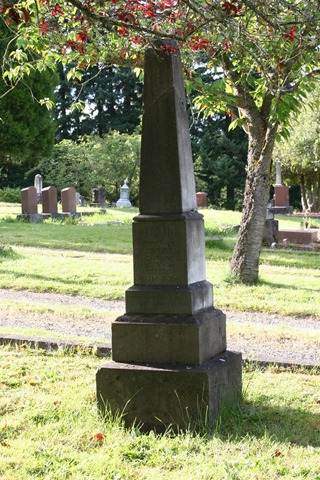
IMG_2179

From the Biography of Daniel Strang (husband):
The year 1862 was a trying one in the annals of Oregon history. It was known as the cholera year and immigration was heavy at that time. Thousands died of that dread disease and were buried along the road, few even having headboards to mark their graves and they were lost to surviving friends for all time. 

Indians were very treacherous and easily set on the war path, so that a return along the trail to the east was a very dangerous undertaking, as but few were going that way and there was always safety in numbers. 

Among the more fortunate of those coming in 1852 was the train made up of Daniel Strang, the Stewarts, Parkers, Ogles, Stevens and the George families, with Mr. George as the captain. There were sixty wagons in the company and much loose stock to be driven along to Oregon. 

Solomon Strang, with his wife Sarah, were the first of the family to come to America. They came from London, England, about. 1807, and settled for a time at Baltimore, Md. Four children, two sons and two daughters, accompanied their parents to America and after a short time the subject of this sketch, Daniel Strang, was born, in 1808. 

In the course of time this family moved to the "west" (Illinois), where Daniel grew to young manhood and was wed to Cynthia Lorton. She was born at Nashville, Tennessee, and had gone out to Illinois with the family of her uncle. 

Cynthia was a true southerner and carried her head high. She was very attractive, bright and witty; a capable housewife and a good manager in her own home and able to make the most of her surroundings, an excellent endowment for pioneer life. 

After the marriage of Daniel Strang they moved still farther west, to Burlington, Iowa, where they settled just three miles out of this little town and kept an inn, called the Three Mile House. 

A large farm surrounded this old brick hostelry and Mr. Strang followed farming as well. There was no market for produce; for instance, eggs were only 3 cents a dozen; hens were $1 a dozen; butter 6 cents a pound, while good oak wood, cut and hauled the three miles to Burlington, only brought $1 per cord. It was not very encouraging to farm under such conditions. 

Mr. Strang became discouraged, saying he wanted to leave a country where the winters were so severe; that all he could raise in the summer he had to feed out during the winter. He had heard of the wonderful Willamette Valley, with its mild climate, and decided to try his luck in that far western country. 

He sold his land, part of it for $40 per acre, while a good share of it only brought $2 per acre. Two years later a railroad came to Burlington and this same land sold for $150 an acre. Besides selling his land so cheaply, they left several hundred chickens on the farm that they could not sell. 

Mrs. Strang never fully sanctioned this move. She loved Iowa and was not entirely satisfied in Oregon. She said, "They always seemed to move just ahead of railroads and peach orchards." They had heretofore just lived in a place long enough to set out an orchard and move on again before it began bearing. 

Mr. Strang, however, was very happy in the Oregon valley of Willamette, wherein he made his permanent home. 

Before they started on the long trek across the plains, Mr. Strang fitted out four covered wagons with false bottoms, under which he stored an ample supply of provisions for the long journey. They emptied two feather beds in each bed-tick, to save space and to get them across. On these they made their beds. 

Mrs. Strang also tucked in among the stuff many little household articles that none but she knew were on board, until near the end of the trip. 

Mr. and Mrs. Strang were devout members of the Cumberland Presbyterian church and it was customary, in this train, to hold religious worship regularly all along the way.  As to politics, Mr. Strang was first a Whig and later on an ardent republican. 

This caravan, that started out early in the spring of 1852, was not troubled much with cholera. Just one young man, a helper, died of this dread disease. 

Mr. Strang believed he saved many lives in his company and others they met along the way with the gallon jug of brandy and the loaf sugar he carried in his wagon. The treatment he used was this:  A few tablespoonfuls of brandy were poured into a dish on some of the precious sugar. This was set on fire and when all the alcohol was burned up the residue was put with a little water and given to the patient.  The writer remembers that this remedy was very extensively used among the pioneers for bowel disorders, with good results, even to the time she was grown and has not forgotten the strong, hot taste of this potion. 

The Indians, however, were very troublesome to the company of which the Strang family were members. Whenever they camped for the night the savages flocked around the train as it corralled for safety, with wagon tongues to the center. They sat about the campfire, peered into the covered wagons, lifted the lids of utensils and otherwise made themselves a nuisance.

They were so meddlesome that the immigrants had to watch everything they possessed, or the Indians would steal from them. They were known to be very treacherous and many tales of massacres by these dusky redmen were rife about camp and caused the white folk to use great caution as to their treatment of the trouble-makers. The least show of hostility upon the part of the travelers would likely mean the extermination of the whole train. 

It was Mrs. Strang's custom to set her salt-rising bread in the morning before the wagons started on and tuck this down under the warm covers to rise. When they camped at night she would bake these savory loaves in her big Dutch oven. 

One night, as she had her baking about ready, she told her little daughter Sarah to stir up the buffalo chip fire, so as to hurry matters. As she complied, she accidentally let a big red-hot chip fall against the foot of an old squaw who sat crowded in about the camp fire so closely as to be in the way. 

This Indian woman set up a raucous wail and from that on, all during the night, kept up her screaming, until a great horde of savages, numbering several hundred, gathered about the train camped on that inhospitable plain. 

At daybreak most of the Indians stole away, but to return to the company again that night, as they were camped a little farther on. This time they came all decked out with war paint and feathers, with many more added to their number. They at once demanded the "pappoose" that had spilled the coals and the innocent cause of all this uproar. All this time the little girl was kept hidden in the wagons. 

Mr. Strang offered the Indians food, money and almost anything, but they harassed the immigrants for two days and nights, until they finally tired of the game and slunk off in small bands, not again to return, much to the peace of mind of our pioneers. After this they had no further trouble, until nearing the Oregon country, one of the little Strang boys, Benjamin, was taken ill of camp fever. He could not eat the coarse camp fare and the problem of a proper diet for the lad was a serious thing, as their milk cows had gone dry because of the lack of feed. 

A little while before they reached The Dalles, Mr. Strang bought three potatoes of an Indian - all he could get. These potatoes they roasted in hot ashes and the little fellow relished them but he begged his mother not to let the other children stand around his bed with their mouths watering for these toothsome tubers, or he could not eat them, since they could not share them with him. 

At The Dalles this company, like many others, took their household goods and human freight down the Columbia River on rafts, while their stock were driven over the mountain trails. 

At Portland, where they landed, Mr. Strang was offered two full "city" blocks in that embryo city in exchange for two yoke of oxen. Mr. Strang did not have much faith in the town and as his oxen were in good order, he would not make a deal. 

The family came on up the Willamette river and camped a while at the Samuel Brown place, near Gervais, Marion county. Because of the continued illness of the little lad, Mrs. Brown invited Mrs. Strang to take the little boy into her house and she assisted the mother in his care, furnishing from her own larder suitable food for the sick child. 

As soon as he was able to travel again, they came on to the little settlement at Salem and camped on the river bank at the location of the present Spaulding mill. Their neighbors at this place (also campers) were the I. R. Moores family, destined, with the Strangs, to become "first citizens" of the city of Salem. 

The little sick boy still needed much nursing and one night during his illness, four old squaws set up a mournful cry, very near their camp. They kept up this wailing for three days and nights, for the burial of an Indian baby, in a near-by tree top, as was their custom. At the end of their journey this family still had some dried apples, dried beef and drier hardtack and a few other articles of food left from their original stock of provisions laid in for the trip, enough to sustain life a little longer. 

A pint of the precious brandy was also left in the bottom of the jug, showing this liquor had not been used except for medicinal purposes or it would have long since been drained to the dregs. 

Our party found Dr. Belt, a pioneer doctor, already ministering to the needs of the immigrants to the best of his ability at the village of Salem. 

Mr. Strang was a brick-mason by trade, but after arriving at Salem, and for many years afterward, kept a hotel in a building owned by a Mr. Ford. In after years he followed farming to good advantage. 

The children of Daniel Strang and his wife Cynthia were all born near Burlington, Iowa, and were:
James, who married Lydia Warner.
Thomas, who married Amelia Schwatka.
Elizabeth, who married William Paddocks.
Benjamin, who married Jeanette Taylor.
Sarah E., who married, first, A. J. Riely; second, E. C. Small.
Mary, who married George Anderson.
Ellen, who married David McAlpin.
One child died in Iowa. 

Sarah Hunt, BOOK OF REMEMBRANCE OF MARION COUNTY, OREGON, PIONEERS 1840 - 1860, Portland, Oregon, The Berncliff Press, 1927, (Source: Mrs. E. H. Small, Salem, Oregon 1926), pp 240-243

Wednesday, July 6, 2011

Oregon Women–Emily Boise

Emily A. (Pratt) Boise

Born: 8 Jan 1828 - Oxford, Massachusetts

Died: 26 Mar 1919 - Salem, Marion Co., Oregon

IMG_1862

IMG_1861

IMG_1864

OBITUARY:
NOTABLE LIFE CLOSES WITH PASSING OF MRS. BOISE, BELOVED PIONEER OF SALEM.

Mrs. R. P. Boise, whose passing at two o’clock a.m. on Wednesday March 26, 1919 was very briefly announced yesterday morning, was one of Salem’s oldest and most prominent residents. Her maiden name was Emily Pratt, born January 8, 1828, at Oxford Mass. The family shortly removed to Webster, Mass., where she grew up, receiving a splendid education. In 1860, she came to Oregon by way of the Isthmus of Panama and Hawaii to Oregon. When she arrived here she took up her residence with her brother; Captain L. W. Pratt, at the Island House, then standing just north of North Mill creek, on Liberty street, which hotel was conducted in connection with the old Willamette Woolen mills, of which Captain Pratt was then superintendent. The woolen mill was some years later destroyed by fire. The Island House was afterwards moved a few hundred feet north and stood there until a dozen or more years ago, when it was burned.

Miss Pratt taught in the Salem public schools until she was married on December 27, 1866, to the late Judge R. P. Boise, for many years honorable and ably connected with the Judicial history and life of Oregon, as circuit judge and justice of the supreme court. Judge Boise passed into the great beyond in Salem on April 10, 1907. After their marriage, they made their home for many years in the historic Jason Lee house, on North Liberty Street, the first house built in Salem. The mills of which Jason Lee himself helped to hew. The house was opposite the missionary saw and grist mills, built soon after.

The children from this marriage were Ellen S. Boise, drowned at Sea View, Wash. In August 1891, and Maria “May”, wife of John H. Lauterman, with whom the deceased had lived for a long time, and whose home at 475 North Summer street she passed quietly and peacefully to rest, as stated, yesterday morning at two, after a very short illness brought on by a severe cold.

Whitney L. Boise of Portland and R. P. Boise of Salem are foster children of the good woman who has gone to her rest. Of the Captain L. E. Pratt children there are: Mrs. May Haas and Mrs. Ida Babcock of Salem, and William E. Pratt of Oregon City. Mrs. C. M. Parmenter, long of Salem, deceased a few years ago, was a sister, and the Parmenter children are Misses Nellie and Anna B. Parmenter and Mrs. H. A. Cornell of Portland, and Charles Parmenter of Salem. A brother of the deceased, Dr. William E. Pratt, was a well-known Boston physician until his death a few years ago.

The good woman gone before was prominent in all things uplifting in this vicinity for a long term of years. She was a member of the First Congregational church. She was a good wife, mother, neighbor, and a true friend. She lived a life of usefulness and faithfulness long beyond the scripturally allotted time, being active for one of her years even up to a day before her passing. The funeral will be from the home at two o’clock tomorrow, under the direction of Rev. W. C. Kantner, pastor of the First Congregational church, and the interment will be in the family plot at the I.O.O.F. cemetery.

Taken from the Chapman Scrapbook:

BOISE--Passing of Mrs. Boise Takes Loved Woman from Community -- The funeral of Mrs. Emily Pratt Boise, who passed to the great beyond March 26, 1919, was held at the home where she lived at 475 North Summer Street, with her daughter and son-in-law, Mr. And Mrs. J. H. Lauterman, on Friday afternoon, March 29. The services were under the direction of Rev. W. C. Kantner, pastor of the First Congregational church, who paid a beautiful tribute to the pioneer woman so loved and honored who had been for so long interested in all good works in Salem and who so peacefully passed to her rest in her ninety-second year. Mrs. Durdall sang beautifully "The Perfect Day." The pall bearers were Supreme Judge T. A. McBride, Charles Weller, J. A. Baker, F. K. Lovell, H. C. Fletcher, and R. J. Hendricks. The floral offerings were many and beautiful. The interment was in Rural cemetery, by the side of her late husband, Judge R. P. Boise, who was so long and so prominently connected with the judicial history of Oregon, serving on the circuit and supreme court benches. Oregon Statesman, April 6, 1919, 5:3-4.

Wednesday, June 29, 2011

Oregon Women - Sarah McBee

The other night I felt extremely overwhelmed.  Things around here have been crazy busy.  The laundry is piling up, the cleaning the garage project is only half done, we haven’t been to the grocery store in three weeks, my car needs washed and cleaned out, there are literally six half finished major craft projects piled on my craft table, I haven’t filed our bill paperwork in four months, there are eight books on my nightstand waiting to be read, and the vacuum cleaner hasn’t seen the light of day in a month.

On top of that, the weather is getting warmer and we don’t have air conditioning.  That means super warm nights that are hard to sleep through.  What does that matter when my alarm is just going to go off at 6:00am to get up for work.  The struggle of digging through an entire closet filled with clothes, and yet I have nothing to wear.  Then there’s the mornings that I hit the snooze one more time and don’t have extra minutes to stand under the hot water while I try to wake up.  These are usually the mornings that I don’t have time to stop by the local coffee shop for my latte and bagel.

I continuously walk by the treadmill in my living room, feeling guilty that I am not walking on it.  Nothing like adding a little extra guilt on top of everything else.  The eating healthy thing has taken a back seat (not a lot of time and energy to do pre-planning for meals).  This means lunch out everyday.  Ugh, I swear I am on a first-named basis with the majority of the drive-up window employees in this town.

So why do I tell you all this.  Let’s go back to a few nights ago when I was feeling extremely overwhelmed.  I had decided to just give up and go to bed.  I picked up one of the eight books staring at me from the nightstand.  This was a new book, one I had picked up the weekend we were in Sumpter.  To be honest, I chose it the other night because it was the thinnest of the stack.  That’s really not the point to this whole story,  The point is how much this book changed my focus on my life.

The book, “Remarkable Oregon Women” is a series of short biographies of the extraordinary women who shaped the state I live in today.  Reading about what these women went through in their lives really made me think of how blessed I am and how petty most of the things I was stressing about are.  These women left everything they had behind and headed west, either by wagon train or by boat (which, in case you were wondering, had to go around the cape of South America).  Either way, it was months of traveling.  They buried family members along the way, gave birth, were attacked by Indians, and most were on the brink of starvation before they reach their destination.  Many would never see the family members they left behind again.

On our recent trip to Salem, Scott and I made a point of stopping by a couple of the pioneer cemeteries.

IMG_2223

I had a list of women I had researched and we were able to locate a few of them.  Their stories are fascinating to me and I want to share them with you.  This is the first installment in a new series I’m calling “Oregon Women”.  Hopefully, you will enjoy getting to know these women also.

Today I want you to meet Sarah McBee.

IMG_1922

IMG_1921

Sarah McBee

Born: 23 May 1826 – Kentucky

Died: 13 Jan 1864 – Salem, Oregon

BIOGRAPHICAL:
Source - Sarah McBee Judson (daughter) in interview with Fred Lockley, Oregon Journal 27 June 1922

"My father, John McBee, who was born in Ohio, came to Oregon in 1852. My mother's maiden name was Sarah Matheny. She was born in Kentucky. My parents had four children when they started by ox team across the plains for the six-months trip to Oregon. John, who was about a year and a half old, died near the Blue Mountains. Ellen, who was a few months old, died not far from where the city of Pendleton now is. Mother's brother, many years later, took the map mother had made showing the location of the graves of her two babies and went up there to put headstones on the graves. He could locate only one of the graves, and it was in a field planted to wheat, so he couldn't tell just where the grave was. My brother George, 6 and Francis, 4½ years old made the trip in safety. My sister Elisabeth was born in 1853, not long after they took up their donation land claim. I was the next child and was born in 1859."


OBITUARY:
Died, in Salem, Marion Co., on the 18th day of January, 1864, Mrs. Sarah McBee, aged 37 years, 7 months and 20 days.

Sister McBee united with the M.E. Church in the State of Missouri, a number of years ago, but was baptized and admitted into full connection by Rev. David Rutledge, during his pastoral relation to this charge. Her Christian experience may be summed up in the apostle's language, "For me to live in Christ, to die is gain." She was taken with diphtheria while watching by the bedside of an afflicted daughter, and in a few hours expired while seated in a chair. Her last words were, "Jesus take me, Jesus take me."

Sister McBee and four of her children are now over the river, while the husband and three children are on this side. May they all at last compose an unbroken family in heaven.
Isaac Dillon
Pacific Christian Advocate 23 January 1864 2:6

NOTES:
1850 MO CENSUS - Sarah McBee, age 25, b. Kentucky, is enumerated with  John McBee, age 31, occupation farmer, b. Ohio, along with George W., age 3, b. Missouri, Frances, age 2, b. Missouri, and John, age 6 months, b. Missouri.
1860 Marion Co. CENSUS lists S. McBee, wife of J. 33 yrs. Born in KY.

SOURCES:
DAR pg 30
1850 MO CENSUS (Ray Co., Dist. #75, FA #577)
OJ 27 June 1922
PCA 23 Jan 1864 2:6